
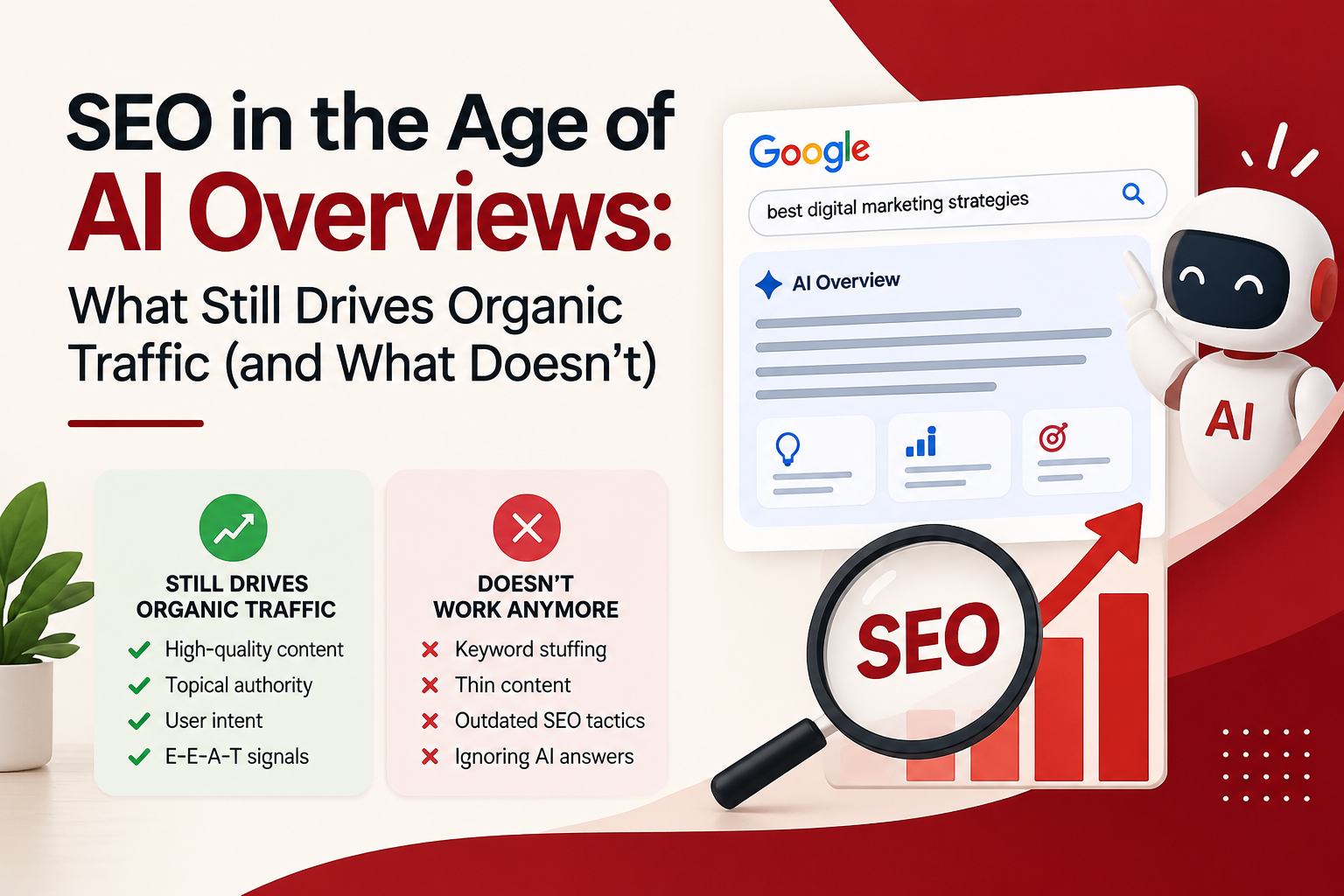
SEO in the Age of AI Overviews: What Still Drives Organic Traffic (and What Doesn't)
Search has changed. Ask Google a question today and you’ll often get a neatly written summary at the very top of the page, before you see a single blue link. For many searchers, that summary is enough, and they leave without clicking anything.
If you run a business or manage marketing, that shift is worrying. The tactics many of us relied on, like stuffing keywords into a page or publishing thin “Top 10” listicles, are losing value fast. AI can produce those in seconds, which means they no longer give anyone a reason to visit your site.
The good news is that organic traffic isn’t disappearing. It’s being redistributed toward content that offers something AI can’t invent. Here are three strategies that still earn visibility, clicks, and trust.
What AI Overviews Changed (and What They Didn't)
AI Overviews are generated summaries that appear above traditional search results. They pull information from multiple sources and present a quick answer.
The impact isn’t equal across all searches:
- Most affected: Simple, factual queries like “what is a meta description” or “how many ounces in a cup”
- Least affected: Complex research, product comparisons, local searches, and transactional queries where people want to evaluate, compare, or buy
The key shift is that ranking is no longer the only goal. Being cited or linked inside these summaries is now a second prize worth chasing.
Myth vs. reality
Myth: “SEO is dead.”
Reality: Search still drives enormous traffic. What’s dead is low-effort content that repeats what everyone else has already said.
Strategy 1: Publish First-Party Content and Original Research
Here’s the uncomfortable truth about generic articles: if you rewrite the top 10 search results in your own words, you’ve added nothing. AI can summarize existing information better and faster than you can.
What AI can’t do is generate information that doesn’t exist yet. That’s where first-party content comes in:
- Original surveys and polls of your customers or industry
- Customer data and internal benchmarks from your own business
- Case studies with real numbers, not vague success stories
- Expert interviews and firsthand experience
This kind of content works because it’s citable, hard to replicate, and naturally earns backlinks. When you’re the source of a statistic, others have to point back to you.
A practical example: A small online store analyzes its yearly sales data and publishes an annual “State of the Industry” post covering which products grew, when customers buy, and what average order values look like. Journalists, bloggers, and even AI tools have a reason to reference it, because the data exists nowhere else.
Starting on a budget: You don’t need a research department. Poll your email list with a five-question survey, mine your support tickets for the most common customer problems, or document a real project from start to finish, including what went wrong.
Strategy 2: Build Authority with Topic Clusters
The old approach was to write one post per keyword and hope each one ranked on its own, often repeating the target phrase awkwardly along the way. That leaves you with a scattered site that never demonstrates real expertise.
The topic cluster model works differently. You create one comprehensive pillar page on a core topic, then support it with more detailed articles on related subtopics. All of them link to each other.
This works because it signals depth. Search engines and AI systems can see that your site covers a subject thoroughly rather than touching it once.
How to build a cluster:
- Pick a core topic tied directly to your business
- Map subtopics and questions your audience actually asks (customer emails and search suggestions are great sources)
- Create the pillar page and supporting posts, each answering one question well
- Link them logically and update them regularly
Picture a hub-and-spoke diagram: the pillar page in the center, with each supporting article connected to it and to related articles. If you sell coffee equipment, your pillar might be “The Complete Guide to Home Brewing,” with spokes covering grind size, water temperature, and choosing a grinder.
Strategy 3: Strengthen Trust Signals (E-E-A-T)
Google’s quality guidelines emphasize E-E-A-T: Experience, Expertise, Authoritativeness, and Trustworthiness. As AI-generated content floods the web, these signals matter more, because they help separate real sources from anonymous filler.
Put them into practice:
- Show real authors. Include bios, credentials, and real names or faces.
- Be transparent about sourcing. Cite where your claims come from and keep dates updated.
- Stay accurate. One outdated or incorrect claim damages trust across your whole site.
- Build your reputation off-site. Reviews, brand mentions, and references from respected sources all count.
Optimize for Being Cited, Not Just Ranked
Once your content has substance, make it easy to find and quote:
- Answer questions clearly near the top of the page, then expand with detail
- Use structured headings, FAQs, and schema markup so machines can parse your content
- Keep pages fast, mobile-friendly, and easy to read
- Track brand mentions in AI answers, not just keyword rankings
Try searching your key topics in AI-powered search tools occasionally and note whether your brand appears. It’s a new kind of visibility metric, and most competitors aren’t watching it yet.